Outsourced debt collection recovery rates may be higher because specialists dedicate their time, systems, and legal knowledge to settling overdue payments. Recovering revenue can be challenging, especially when business owners must balance client management with strategically following up on outstanding invoices. Data reveals that 63% of Australian small and medium-sized…

Knowing when to escalate late payments is crucial when routine collection efforts are no longer producing results. Leaving overdue accounts unresolved can strain cash flow needed for daily expenses and increase default risk. According to reports, Australian small businesses were paid an average of 6.0 days late in June 2026…
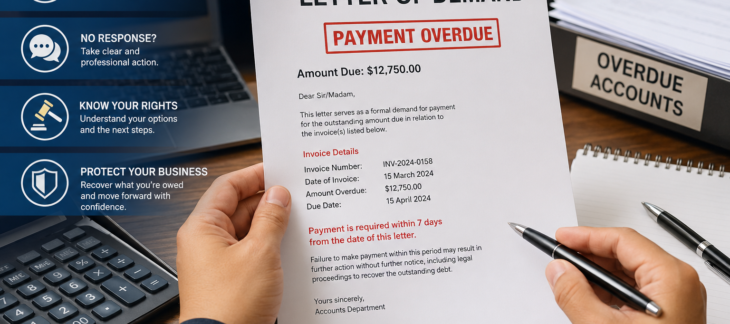
A letter of demand may be ignored for several reasons, including unclear payment deadlines, overly emotional language, unrealistic demands, missing supporting information, or repeated threats that are never followed by action. For businesses dealing with overdue invoices, an effective letter of demand should clearly identify the debt, explain what payment…
Effective cash flow management is essential to doing business in Australia. If B2B invoices become overdue, commercial debt collection must change depending on whether the debt is secured or unsecured. The primary difference is the use of assets: secured debts allow the creditors to take possession of some of the…
The accumulation of bad debts in an Australian company usually reaches a crucial point at which one must decide how to collect the money owed. To solve that problem, organisations have two choices of professionals: debt collectors or legal professionals. The aim in both cases is the same, but the…
Cash flow is the lifeblood of a business. So when receivables are delayed, operations come under pressure. In fact, Australian business owners are already feeling this strain. According to the Payment Times Reporting Regulator, roughly 30% of invoices miss the standard 30-day payment window. Despite recent government reforms like the…
Nearly one in two Australians with debt (equivalent to 5.8 million people) struggle to meet their repayment obligations. These cases depict a growing share of overdue accounts that are not caused by an unwillingness to pay, but by reduced capacity from cost-of-living pressures or reduced income. For merchants, this presents…
Payment timelines of 15 to 30 days are generally considered the standard in many industries. However, the increasing demand for flexible payment terms is pushing merchants into extending these periods. According to CAPS Research, 38% of manufacturing and service sectors use the 45-day payment terms, 1% implement 75-day, and 11%…
The Australian Bureau of Statistics’ latest publication shows that the country’s gross domestic product (GDP) rose by 0.4% in the September 2025 quarter. This is good news as it signals that the overall economic activity is expanding. However, when this output is adjusted for population growth, the GDP per capita…
Late payments create persistent pressure for small and mid-sized enterprises (SMEs). The challenge intensifies once debt late payment penalties are involved. Many businesses understand penalties exist to protect revenue, yet hesitation follows quickly. Fear of client backlash, concern over legal exposure, and uncertainty around enforcement cause many firms to…
Financial stability is shaped by the systems that sit behind everyday transactions. However, without structure, delays in collections can quietly undermine financial planning. In invoices, payment terms are the agreed-upon conditions specifying when and how a buyer must pay the seller for goods or services rendered. They provide structure by…
An invoice dispute is a recourse given to customers against billing errors. When they spot amount discrepancies or have concerns about not receiving the correct product, clients are granted the right to contact the business to address and resolve the issue. This right is grounded in the Australian Consumer Law…